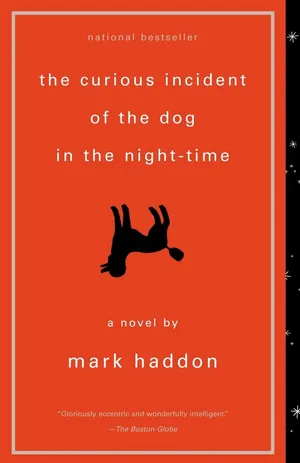
Our Review
Christopher John Francis Boone is fifteen years old. He knows all the countries of the world and their capitals and every prime number up to 7,057. He understands maths and logic with effortless precision. He cannot understand facial expressions, metaphors, or jokes. When he discovers the neighbor's dog dead on the lawn, stabbed with a garden fork, he decides to investigate — modeling his inquiry on the methods of Sherlock Holmes, his favorite fictional detective.
Published in 2003, The Curious Incident of the Dog in the Night-Time is narrated entirely by Christopher, and the effect is extraordinary. Haddon does not write about Christopher from the outside. He writes from within Christopher's mind, and that mind — hyperlogical, brutally honest, overwhelmed by sensory input, incapable of deception — transforms the world into something simultaneously familiar and alien. A trip to a train station, which most readers would barely notice, becomes a terrifying odyssey when experienced through Christopher's heightened senses.
The mystery of the dead dog turns out to be the gateway to a much larger family secret, and watching Christopher navigate that secret — with tools that are brilliant for solving mathematical problems and catastrophically inadequate for handling emotional chaos — is both heartbreaking and frequently very funny. The novel works as a mystery, a coming-of-age story, and an extraordinary exercise in empathy. By the time you finish, you understand something about how differently other people experience the world that you did not understand before.
Why This Book Earned Its Place in the Top 100
The Curious Incident earns its place because it achieves something genuinely rare: it changes the way you perceive reality. By committing fully to Christopher's perspective — his love of prime numbers, his terror of being touched, his inability to process lies — Haddon forces the reader to experience the world through a radically different consciousness. This is not sentimentality or pity. It is the real work of literature: expanding the boundaries of what you can imagine another person's life feels like.
The book also succeeds on purely narrative terms. The mystery is engaging. The family drama is devastating. The set pieces — Christopher's journey alone across London, his mathematical digressions, his attempts to understand why people say things they do not mean — are inventive and compelling. And the novel manages to be deeply compassionate without ever being condescending. Christopher is not presented as a victim or an inspiration. He is presented as a person: limited in some ways, gifted in others, trying to make sense of a world that was not designed for him. That last quality, of course, is something every reader can recognize.
Who Should Read This Book
- •Anyone who wants to understand neurodiversity — the novel offers a more visceral and empathetic understanding of how differently some minds work than any textbook or documentary.
- •Young adult and adult readers alike — the book was published simultaneously for both audiences and works brilliantly for either.
- •Parents and educators — Christopher's struggles illuminate the gap between how neurotypical institutions function and how neurodivergent individuals experience them.
- •Mystery lovers — the investigation is genuinely engaging, and Christopher's logical approach to detection is both effective and endearing.
- •Readers who think literary fiction is boring — this is one of the most gripping, fast-paced literary novels of the 21st century.
Key Themes and Takeaways
- Neurodiversity and perception
- Christopher's mind processes the world in fundamentally different ways — not worse, not better, but different — and the novel insists that difference be respected.
- Truth and deception
- Christopher cannot lie and cannot understand why others do; the novel reveals how much of ordinary social life depends on dishonesty.
- Family dysfunction
- The mystery of the dead dog leads to revelations about Christopher's family that are far more disturbing than the original crime.
- Independence and capability
- Christopher's solo journey across London proves that he is far more capable than the adults in his life have assumed.
- Logic versus emotion
- Christopher's mathematical brilliance coexists with emotional overwhelm, and the novel explores both as legitimate ways of engaging with reality.
Cultural and Historical Impact
The Curious Incident of the Dog in the Night-Time was published in 2003 and became an immediate international bestseller, selling over two million copies in its first three years. It won the Whitbread Book of the Year Award (now the Costa Book Award) and the Guardian Children's Fiction Prize. The novel was adapted into a hugely successful stage play by Simon Stephens, which premiered at the National Theatre in London in 2012 and transferred to the West End and Broadway, winning seven Olivier Awards and five Tony Awards, including Best Play. The book has been translated into more than 40 languages. It is widely credited with increasing public understanding of autism and neurodiversity, though Haddon has noted that the word "autism" never appears in the novel. It remains one of the most commonly assigned novels in British and American secondary schools.
Notable Quotes
“I think prime numbers are like life. They are very logical but you could never work out the rules, even if you spent all your time thinking about them.”
“And when you look at the sky you know you are looking at stars which are hundreds and thousands of light-years away from you. And some of the stars don't even exist anymore because their light has taken so long to get to us that they are already dead.”
“I like dogs. You always know what a dog is thinking. It has four moods. Happy, sad, cross and concentrating. Also, dogs are faithful and they do not tell lies because they cannot talk.”
If You Loved The Curious Incident of the Dog in the Night-Time, Read These Next
Ready to read The Curious Incident of the Dog in the Night-Time?
Vintage Contemporaries · 226 pages
Buy The Curious Incident of the Dog in the Night-Time on Amazon