Our Review
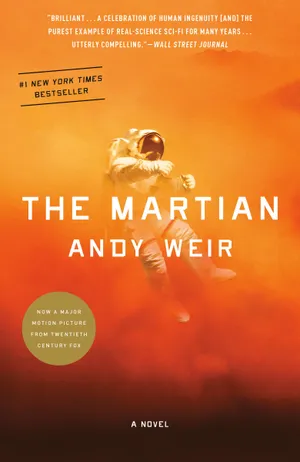
Mark Watney is having a bad day. A dust storm on Mars has forced his crew to abort their mission and evacuate, and in the chaos, Watney was struck by debris, his suit sensor flatlined, and his crewmates — reasonably believing him dead — left without him. He wakes up alone on Mars with a damaged habitat, limited supplies, no way to communicate with Earth, and the next scheduled Mars mission four years away.
So he does what any botanist-engineer with a dark sense of humor would do: he starts problem-solving. Watney's voice — profane, self-deprecating, relentlessly practical — is the engine of The Martian. "I'm going to have to science the shit out of this," he declares early on, and the novel delivers exactly that. He grows potatoes in Martian soil fertilized with human waste. He manufactures water through chemistry that could kill him. He hacks together communication with NASA from spare parts. Every solution creates new problems, and every chapter is a fresh exercise in ingenuity.
Andy Weir's debut novel, originally self-published as a serial on his blog, is a love letter to human intelligence and determination. The science is real — Weir researched every detail obsessively — and the tension of whether each improvised solution will work is genuinely gripping. But what makes the novel special is Watney himself, whose refusal to give up is not heroic bluster but practical stubbornness. He doesn't want to die on Mars. So he works the problem.
Why This Book Earned Its Place in the Top 100
The Martian earns its place by being that rarest of things: a novel about science that makes science thrilling. Weir demonstrated that hard science fiction — fiction where the physics, chemistry, and biology are accurate and central to the plot — could appeal to a massive general audience without dumbing anything down. Every calculation Watney makes is real. Every solution he engineers is plausible. And somehow, pages of orbital mechanics and atmospheric chemistry are as tense as any action sequence.
The novel also represents a uniquely optimistic vision at a time when most science fiction trends dark. There are no villains in The Martian — no corporate conspiracies, no government coverups, no interpersonal betrayals. Instead, the entire world rallies to save one man, and the novel argues that human beings, when presented with a solvable problem, will solve it. That faith in collective intelligence and determination is unfashionable, and it is also deeply moving.
Finally, The Martian's origin story — self-published on a blog, picked up by a small press, then acquired by a major publisher after going viral — represents a genuine shift in how books reach readers. It proved that the old gatekeeping model is not the only path to literary impact.
Who Should Read This Book
- •Anyone who loves problem-solving — each chapter presents a new engineering challenge, and watching Watney work through them is addictive.
- •Science enthusiasts — the science is accurate, clearly explained, and central to every plot point, making this one of the best hard sci-fi novels ever written.
- •Readers who want optimistic fiction — in a genre dominated by dystopias, The Martian's belief in human ingenuity and cooperation is refreshing and genuine.
- •People who think they don't like science fiction — Watney's voice is so funny and accessible that the genre trappings fall away immediately.
- •Fans of survival narratives — this is Robinson Crusoe on Mars, and the stakes could not be higher.
Key Themes and Takeaways
- Human ingenuity and problem-solving
- The novel is fundamentally a celebration of the human capacity to think, improvise, and refuse to accept impossible odds.
- Isolation and resilience
- Watney's solitude on Mars tests the limits of psychological endurance, and his humor becomes a survival tool as vital as any piece of equipment.
- Collective effort and cooperation
- The rescue involves NASA, JPL, China's space agency, and Watney's own crew, arguing that humanity's greatest achievements require collaboration across borders.
- Science as salvation
- The novel makes an unapologetic case that scientific knowledge — not faith, not luck, not heroism — is what keeps Watney alive.
- The value of a single life
- The enormous resources spent to save one person argue that every human life is worth an extraordinary effort.
Cultural and Historical Impact
Originally self-published on Andy Weir's blog in 2011 and released as a Kindle ebook in 2012, The Martian was picked up by Crown Publishing in 2014 and became a massive bestseller, spending over 60 weeks on the New York Times bestseller list. Ridley Scott's 2015 film adaptation, starring Matt Damon, grossed over $630 million worldwide and received seven Academy Award nominations including Best Picture. The novel is credited with helping revive popular interest in Mars exploration and NASA reported increased public engagement following the film's release. Weir has been invited to speak at NASA and JPL, and the novel is used in STEM education programs as an example of accessible scientific communication. It remains one of the bestselling science fiction novels of the 2010s.
Notable Quotes
“I'm going to have to science the shit out of this.”
“If a hiker gets lost in the mountains, people will coordinate a search. If a train crashes, people will line up to give blood. If an earthquake levels a city, people all over the world will send emergency supplies. This is so fundamentally human that it's found in every culture without exception.”
“Yes, of course duct tape works in a near-vacuum. Duct tape works anywhere. Duct tape is magic and should be worshipped.”
If You Loved The Martian, Read These Next


Ready to read The Martian?
Crown · 369 pages
Buy The Martian on Amazon