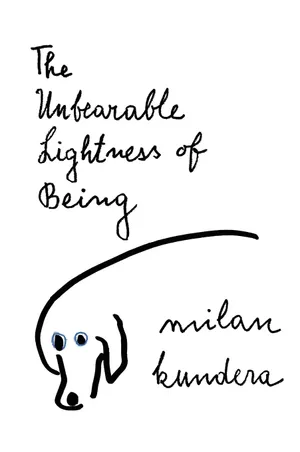
Our Review
Milan Kundera's masterwork opens with a meditation on Nietzsche's concept of eternal return and never lets your mind rest after that. Set against the backdrop of the 1968 Soviet invasion of Czechoslovakia, the novel follows four characters — Tomas, Tereza, Sabina, and Franz — whose tangled romantic lives become the vehicle for Kundera's deepest questions about existence, commitment, and the weight of our choices.
Tomas is a brilliant Prague surgeon torn between his devoted wife Tereza and his compulsive womanizing. Tereza is haunted by jealousy and dreams so vivid they bleed into waking life. Sabina, Tomas's principal mistress, is an artist who lives by a philosophy of betrayal — not cruelty, but a refusal to be pinned down by anything. Franz, Sabina's lover in Geneva, is a gentle academic who mistakes political gestures for meaning.
What makes this novel extraordinary is that Kundera refuses to hide behind his characters. He interrupts, philosophizes, and dissects their motivations in real time. The book is simultaneously a love story, a political novel, and a philosophical essay — and somehow it works as all three. Kundera asks whether a life lived only once, with no chance of correction, can ever truly matter. His answer is devastating, generous, and entirely unresolved.
Why This Book Earned Its Place in the Top 100
The Unbearable Lightness of Being occupies a space in literature that almost no other novel does: it is genuinely philosophical without being academic, and genuinely erotic without being gratuitous. Kundera managed to write a book that treats sex, politics, and metaphysics as facets of the same human predicament — and he did it with prose so elegant it reads like music.
Beyond its literary achievement, this novel gave millions of readers their first encounter with Central European intellectual life and with the real human cost of Soviet occupation. It made people think about the difference between lightness and weight, between kitsch and authenticity, between living freely and living meaningfully. These are not abstract problems. They are the problems everyone faces when they decide whether to stay or leave, commit or flee, speak or remain silent.
Few novels from the 1980s remain this alive. Kundera's questions have only grown more pressing in a world that offers infinite choice and very little guidance about what any of it means.
Who Should Read This Book
- •Readers who love novels that think — if you want fiction that wrestles with genuine philosophical questions without sacrificing story or character, this is the gold standard.
- •Anyone fascinated by Cold War-era Central Europe — Kundera captures the texture of life under Soviet occupation with the precision of someone who lived it.
- •Readers who appreciate complex love stories — the relationships here are messy, contradictory, and painfully real in ways that most romance never attempts.
- •Fans of authors like Dostoevsky or Camus who blend narrative with ideas — Kundera belongs in that tradition and extends it.
- •Anyone questioning what makes a life meaningful — the novel's central paradox about lightness and weight will stay with you for years.
Key Themes and Takeaways
- Lightness versus weight
- Kundera explores whether freedom from commitment liberates us or renders our lives meaningless.
- Kitsch and authenticity
- The novel defines kitsch as the denial of everything unacceptable about existence and examines how it poisons both politics and love.
- Political oppression and private life
- The Soviet invasion is not backdrop — it is the force that tests every character's values and reveals who they actually are.
- The body and the soul
- Tereza's struggle to reconcile her physical self with her inner life is one of the novel's most searching threads.
- Eternal return and the unrepeatable life
- If we live only once, Kundera asks, is our existence as weightless as a single sketch never corrected?
Cultural and Historical Impact
Published in 1984, The Unbearable Lightness of Being was an international sensation, translated into dozens of languages and selling millions of copies worldwide. It made Kundera the most famous Czech writer since Kafka. Philip Kaufman's 1988 film adaptation starring Daniel Day-Lewis and Juliette Binoche brought the story to mainstream audiences, though Kundera himself was famously ambivalent about the result. The novel introduced the concept of "kitsch" as a philosophical category to a global readership and became essential reading in university philosophy and literature courses. It remains Kundera's defining achievement, the book that proved literary fiction could be both intellectually rigorous and a genuine page-turner.
Notable Quotes
“We can never know what to want, because, living only one life, we can neither compare it with our previous lives nor perfect it in our lives to come.”
“The heaviest of burdens crushes us, we sink beneath it, it pins us to the ground. But in the love poetry of every age, the woman longs to be weighed down by the man's body. The heaviest of burdens is therefore simultaneously an image of life's most intense fulfillment.”
“Dogs are our link to paradise. They don't know evil or jealousy or discontent.”
If You Loved The Unbearable Lightness of Being, Read These Next




Ready to read The Unbearable Lightness of Being?
Harper Perennial Modern Classics · 314 pages
Buy The Unbearable Lightness of Being on Amazon