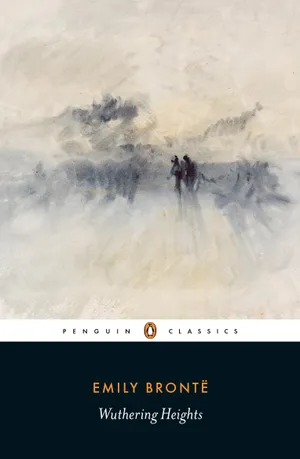
Our Review
Emily Brontë's "Wuthering Heights" is one of the strangest, most ferocious, and most unforgettable novels in the English language. It is frequently shelved alongside its sister novel "Jane Eyre" as a romance, but that label is wildly misleading. This is not a love story — or if it is, it is a love story in the way that a wildfire is a campfire. The passion between Heathcliff and Catherine Earnshaw is not tender or uplifting; it is obsessive, destructive, and terrifying in its intensity, a force that devours everyone it touches across two generations.
The novel's structure is as wild as its content. The story is narrated primarily by Nelly Dean, the housekeeper, to Mr. Lockwood, a bemused tenant, and it spirals backward and forward through time as it traces how Heathcliff — a foundling brought to Wuthering Heights as a child — is raised alongside Catherine, falls into an all-consuming bond with her, is driven away by humiliation, returns transformed into a gentleman of mysterious wealth, and proceeds to systematically destroy the two families who wronged him.
Brontë wrote this novel at the age of twenty-nine, having spent nearly her entire life on the Yorkshire moors. She died a year after its publication and never knew it would become one of the most celebrated works of fiction in history. The novel bewildered its first readers, who found it savage and morally repugnant. They were right that it is savage — but that is precisely its genius. Brontë refused to domesticate passion, to tidy it into something comfortable. She put the full, ungovernable force of human desire on the page and dared the reader to look at it.
Why This Book Earned Its Place in the Top 100
"Wuthering Heights" belongs on this list because no other novel in the English language captures the raw, destructive power of obsessive love with such unflinching honesty. Brontë was not interested in the polite courtship rituals of Austen or even the moral conflicts of her sister Charlotte. She went straight to the primal heart of human passion — the place where love and hate are indistinguishable, where desire is indistinguishable from destruction — and she wrote it with a fearlessness that still shocks readers almost two centuries later.
The novel also represents a remarkable literary achievement on purely formal grounds. Its nested narrative structure — a story within a story within a story — was avant-garde for 1847, and its refusal to provide a reliable moral perspective forces the reader to make their own judgments about characters who resist easy categorization. Heathcliff is one of literature's most complex creations: simultaneously a victim of class cruelty, a tragic romantic, and a genuine monster.
Beyond its literary merits, "Wuthering Heights" expanded what the English novel was capable of. It brought the wild, the mythic, and the supernatural into a form that had been largely concerned with social realism, proving that the novel could channel the same elemental forces as poetry and tragedy. Emily Brontë wrote one novel. It was enough.
Who Should Read This Book
- •Readers who want to experience passion at its most extreme — Heathcliff and Catherine's bond is unlike any other love story in literature, and it will leave you shaken.
- •Fans of Gothic fiction — the Yorkshire moors, the haunted houses, the ghostly visitations create an atmosphere of eerie, compelling dread.
- •Anyone who loved 'Jane Eyre' and wants to see the other side of the Brontë imagination — where Charlotte wrote moral clarity, Emily wrote moral chaos.
- •Literary adventurers willing to grapple with morally complex characters — there are no heroes in this novel, and its refusal to judge is part of its power.
- •Readers interested in early feminist literature — Brontë wrote under a male pseudonym and produced one of the most original works of imagination the Victorian era produced.
Key Themes and Takeaways
- Obsessive, destructive love
- Catherine and Heathcliff's bond transcends conventional romance — it is a merging of identities so complete that separation feels like a form of death.
- Revenge and its futility
- Heathcliff's systematic destruction of the Earnshaw and Linton families shows how the desire for vengeance consumes the avenger as much as the victim.
- Class and social cruelty
- Heathcliff's treatment as a child — degraded because of his origins — is the seed from which all the novel's violence grows, indicting the class system that created him.
- Nature and wildness
- The Yorkshire moors are not mere setting but a character in the novel, embodying the untamed forces that drive Heathcliff and Catherine.
- The boundary between life and death
- Ghosts, haunting, and the desire to transcend death pervade the novel, suggesting that the deepest human bonds cannot be severed even by mortality.
- Generational trauma
- The second generation of characters inherits and ultimately must resolve the damage inflicted by their parents, suggesting that violence begets violence until someone chooses differently.
Cultural and Historical Impact
"Wuthering Heights" was published in 1847 under the pseudonym Ellis Bell and received mixed reviews — many critics found it powerful but morally disturbing. Emily Brontë died of tuberculosis in 1848, never knowing the novel's future fame. It is now universally recognized as one of the greatest novels in the English language and appears on virtually every major list of essential literature. The novel has been adapted into dozens of films, including William Wyler's classic 1939 version starring Laurence Olivier, and a notable 2011 adaptation by Andrea Arnold. Kate Bush's 1978 debut single "Wuthering Heights" — written when she was just eighteen — became a number-one hit in the UK and introduced the novel to a new generation. The Brontë Parsonage Museum in Haworth, Yorkshire attracts hundreds of thousands of visitors annually. The novel fundamentally influenced the Gothic tradition and the literary exploration of the irrational, paving the way for everyone from the Surrealists to modern dark romance.
Notable Quotes
“Whatever our souls are made of, his and mine are the same.”
“I am Heathcliff! He's always, always in my mind: not as a pleasure, any more than I am always a pleasure to myself, but as my own being.”
“If all else perished, and he remained, I should still continue to be; and if all else remained, and he were annihilated, the universe would turn to a mighty stranger.”
If You Loved Wuthering Heights, Read These Next
Ready to read Wuthering Heights?
Penguin Classics · 416 pages
Buy Wuthering Heights on Amazon